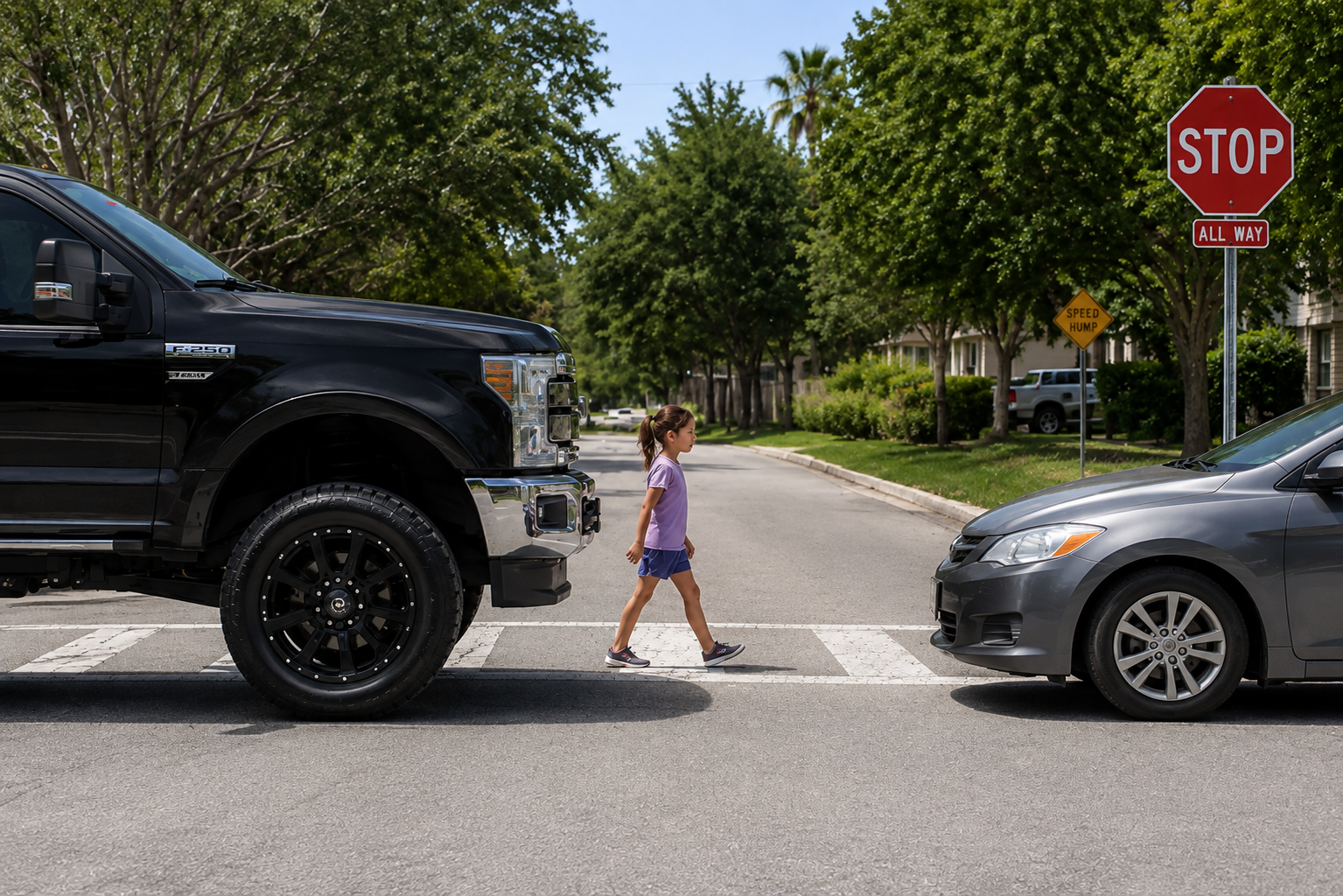
When you test drive a new car, look past the seat comfort and the gas mileage and check what you can actually see from the driver’s seat. Manufacturers have raised hood heights and thickened the A-pillars – the posts on either side of the windshield that tie the body to the roof – and both changes shrink what a driver can see directly ahead and off to each side.
Since 2009, the number of pedestrians killed each year has increased by almost 75 percent. A recent New York Times investigation revealed that an estimated 200 to 400 pedestrians a year were killed due to insufficient sight lines in vehicles and higher bumpers.
The New York Times researchers found that the bumper on a sedan from 2002 is 21 inches lower than a 2022 Chevrolet Silverado. This increased bumper height is putting pedestrians in danger. The hood height of an average passenger vehicle is also an issue. They average about three feet, so the sight lines extending beyond the hood mean about half of American adults and almost all small children are invisible to the drivers of these large vehicles.
The Insurance Institute for Highway Safety (IIHS) found vehicles with a hood height greater than 40 inches are 45 percent more likely to cause fatalities in pedestrian incidents than cars and vehicles with a hood height of 30 inches or less with a sloping profile.
The stats tell the story but so do the measurements. Since 1996, the average U.S. passenger vehicle is four inches wider, ten inches longer, eight inches taller, and 1,000 pounds heavier.
A senior researcher at IIHS suggests vehicle manufacturers should lower the front end of the hood and angle the grille and hood to make a sloped profile.
It is not just pedestrians at risk with these larger and taller vehicles. The height differences are also a danger for passengers in smaller cars.
At Penn Law, we have worked with families devastated by car wrecks with lifted vehicles. In some cases, the “lifts” were only a few inches higher than the height of some current SUVs and pickup trucks. We are finding that the rears of the cars on the road are often not prepared for the front of large, lifted vehicles.
Some new cars now have advanced safety systems that alert drivers of obstacles or people in the vehicle’s path. However, a 2021 Consumer Reports study found pickup trucks are less likely than sedans to have safety features like automatic emergency braking. Recent years have shown improvement in safety features but they have also shown increased hood and bumper height of the trucks.
Sales data from this year shows the Ford F-Series is the top selling vehicle, followed by the Chevrolet Silverado, and rounding out the top three is the Honda CR-V. Here are the hood heights for each vehicle:
Ford F-Series – 50 to 51 inches
Chevrolet Silverado – 45 to 50 inches
Honda CR-V – 30 to 35 inches
Until consumers demand something be done about the height differential in vehicles, manufacturers will continue to make vehicles larger and larger. The demand must come from us.


